

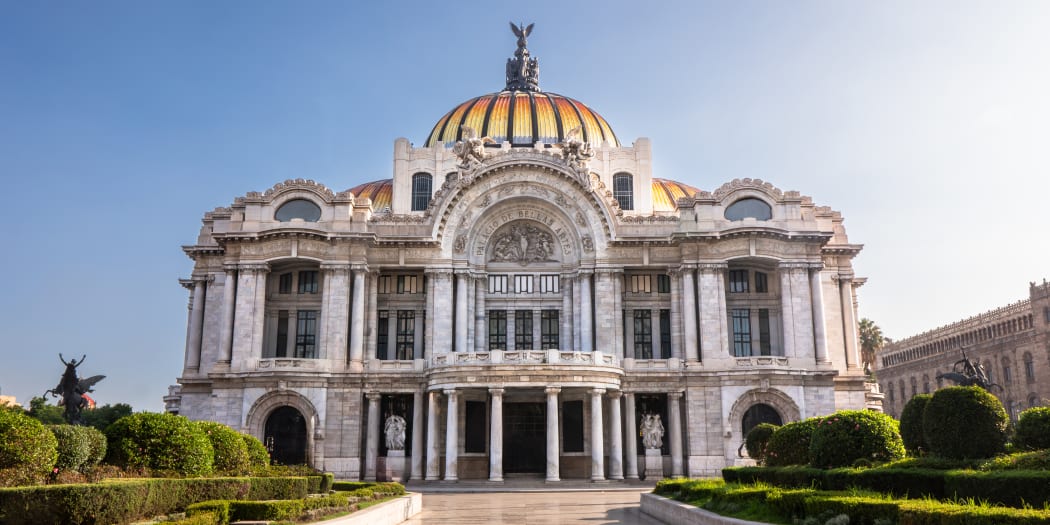
An Architectural Wonder
Palacio de Bellas Artes is perhaps the most grand and elegant work of architecture in Mexico City’s historic center. Inspired by the great theaters and opera houses of Europe, the building’s classic European architecture reflects the reverence that Mexico’s elite held for European design and culture at the turn of the 20th century.
Construction began originally in 1904 under the presidency of Porfirio Diaz, with the project expected to take just four years and be open in time to commemorate the centenary of Mexico’s independence from Spain in 1910.
As with many of Mexico City’s great architectural projects from the Porfirio Díaz era, the design took its inspiration from the capitals of Europe. The project’s Italian architect, Adamo Boari, made several trips to visit the opera house’s of the continent’s capitals. Boari incorporated neoclassical and art nouveau elements into his design for a palatial building at the heart of Mexico City.
The construction was beset with challenges as the heavy marble sank into the soft subsoil of an area which was formerly a lakebed. After missing the initial planned opening for the centenary of Independence, the breakout of fighting in the Mexican Revolution drained government finances forcing construction to be brought to a halt.
The partially-finished building stood abandoned from 1917 until 1930, when Mexico’s post-revolutionary government decided to revive the project. Now led by a Mexican architect, Federico Mariscal, the more contemporary Art Deco style was incorporated into the building’s design.

An Ode to the Revolution
By the time the building opened to the public in 1934, the Mexican state had changed dramatically.
Porfirio Diaz mode of governance focused on Mexico’s elites had been ousted by the Mexican Revolution. In its place, the post-revolutionary state placed greater value on democracy and inclusivity.
Palacio de Bellas Artes was reenvisaged in this light, less as a monument to Mexico’s European-oriented elites but as a cultural center for all Mexicans.
By the 1930s the muralist art movement was sweeping Mexico, with great works of art commissioned to encapsulate the values of the post-revolution nation. Since its inauguration in 1934, Palacio de Bellas Artes has showcased the best work from the muralist movement.
The muralist art movement aimed to shape popular understanding of Mexico’s history. Vast murals were commissioned to cover public buildings, often funded by the post-revolutionary government, which depicted the country’s past, present and future with overt political, social and historical messages. Many of these epic works of art from some of Mexico’s greatest muralists are on display permanently across two floors of Palacio de Bellas Artes.
The walls of the first floor are occupied by two pieces from muralist Rufino Tamayo:
- Nacimiento de nuestra nacionalidad (Birth of our Nationality) represents the origins of the mestizo, people of mixed indigenous and Spanish descent that form the core of the Mexican nation.
- México de hoy (Mexico Today) likewise depicts the Mexican nation as a fusion of pre-Hispanic and European influences, with three sections of the image evoking the colors of the Mexican flag.
Two works by Diego Rivera are on display on the second floor:
- El hombre controlador del universo (Man, Controller of the Universe) is a vision of technological advancements originally intended for the Rockefeller Centre in New York, but due to controversy over the inclusion of Lenin and a Soviet May Day parade, the original in New York was painted over with Rivera later recreating the work for display in Palacio de Bellas Artes.
- Carnaval de la vida mexicana (Carnival of Mexican Life) was inspired by the traditional carnival of Huejotzingo in the state of Puebla but filled with satirical political and societal references.
Two dramatic works by David Alfaro Siqueiros have strong historical and political themes:
- La nueva democracía (The New Democracy) celebrates the triumph of democracy against totalitarianism in the Second World War whilst highlighting the suffering the war inflicted on civilians.
- Tormento de Cuauhtémoc (The Torment of Cuauhtémoc) brutally represents the conquistadors burning the feet of Cuauhtémoc and Tetlepanquetzal, the final Aztec governors of Tenochtitlan and Tacuba.
Also of note is a mural by José Clemente Orozco, Katharsis, an apocalyptic depiction of war, mass protest and chaos in modern society.
The building is also home to a 1,600-seat theatre. Some of Mexico’s top performing arts institutions regularly perform here, including the Folklore Ballet of Mexico and the National Symphonic Orchestra.