
Commemorating Mexican Independence
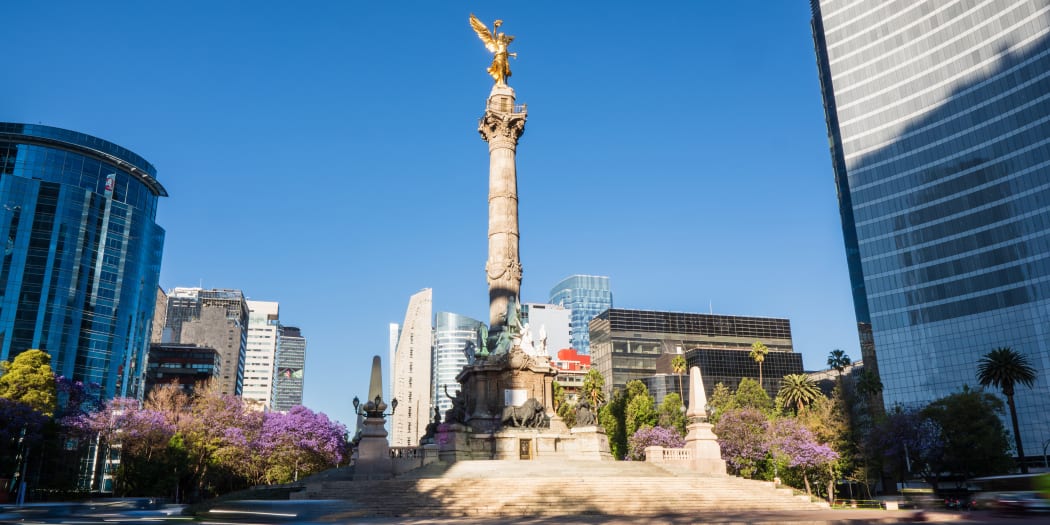
The Angel of Independence commemorates Mexico’s victory in the War of Independence from Spain. The monument’s inauguration on September 16, 1910 marked the 100th anniversary of El Grito de Dolores, when Miguel Hidalgo rang the bells of his church in Dolores, Hidalgo, summoning the people of his parish to arms in a moment widely considered to be the start of Mexico’s War of Independence.
Hidalgo’s remains are now laid to rest in a mausoleum inside the Angel of Independence, alongside thirteen other prominent insurgents.
The monument was commissioned by President Porfirio Diaz, envisaged as the centerpiece of a series of events to mark the centenary of Mexican Independence in 1910.
Diaz had ruled Mexico as a president-dictator for over three decades, and by 1910 his authoritarian rule was increasingly unpopular. Despite presiding over an economic boom as the Mexican economy opened up to foreign investment, this had failed to raise living standards for many, with widespread poverty, inequality and atrocious working conditions.
By the time the Angel of Independence was inaugurated in 1910, Diaz was in the final months of his presidency. The Mexican Revolution would begin later that year, removing Diaz from power and kicking off a decade-long series of conflicts that would unleash chaos, suffering and political turmoil but would ultimately bring Mexico into the modern era with a transformed government, society and constitution.
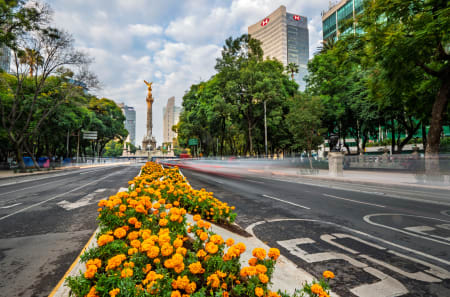
Following the revolution, the Angel of Independence became a focal point for the city. Political protests gather below El Ángel to march to the Palacio Nacional. Crowds take to the street below the monument to celebrate Mexico’s football victories.
Avenida Paseo de la Reforma
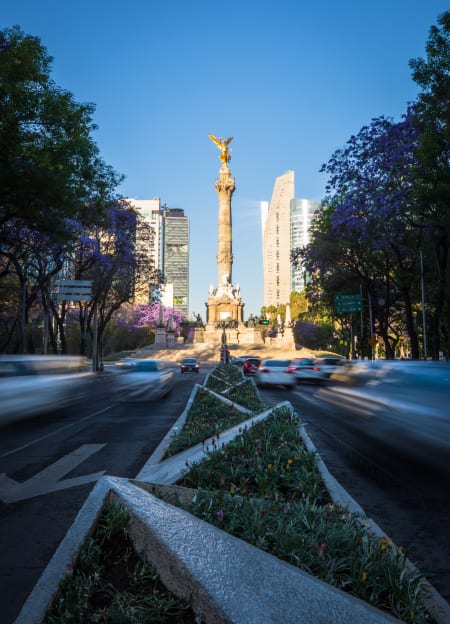
The Angel of Independence sits in the centre of Mexico City’s most famous boulevard, Avenida Paseo de la Reforma, the grand imperial vision of Emperor Maximilian I.
Maximilian ruled Mexico during France’s brief intervention in the 1860s, after Napoleon III invaded. Ostensibly the French intervention was caused by a dispute over unpaid debt, but a more likely motivation was a desire to match Britain as an imperial power and limit the expansion of the Protestant United States.
From his home in Chapultepec Castle, Maximilian envisioned a grand avenue similar the Champs-Élysées in Paris. The avenue would run from the entrance of Chapultepec Castle, through what was at the time undeveloped ranches and forest, into the heart of the Centro Histórico to reach the Palacio Nacional in the Zocalo.
Over the 19th and 20th centuries, as the city expanded to the west, Avenida Paseo de la Reforma has become the bustling heart of the city’s business and financial district.